|
|











Prayer Groups 1st Friday Mass Young Adults Teens Kids Prayer Requests Holy Spirit Conference Donations


Site-Map | 1st Friday Mass | Prayer Groups | Renewal Board | About | Calendar | Contact | Main |
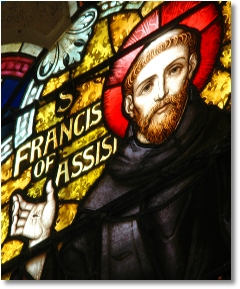
It was a hot, humid day, the road was steep and Francis, whose family had long since rejected him, came face to face with his younger brother. The brother looked at him over superciliously. "For how much will you sell me your sweat, Francis?" Francis shook his head, "I can get a higher price from God." Beyond his brother he saw his father, Pietro Bernadone. The old man spat at him and cursed. They had been through all this before. "These days, I only call God in heaven, my Father," he replied, "but I must have someone to bless me". Francis turned to the old beggar who followed him. " You give me a Father's blessing, old Uncle," he said, and knelt at the beggar's feet. Like Nazareth, Assisi was an ordinary town. It took great perseverance and miracles to impress inhabitants so reluctant to have prophets in their midst. Francis was born in 1181. He belonged to the minores - the non-noble end of the town, (unlike Clare, who was one of the, majores, the aristocracy) His father, a rich merchant bent on social climbing, had him educated with knighthood in view. When in a political shake up the Imperial nobility, Clare along with them, were exiled, Francis would have been among those who helped to pull down the Rocca, the residence of the Imperial Vicar. However, the wheel turned and Francis found himself a prisoner of war in Perugia. In the miserable wait to be ransomed, God slowly began inserting new ideas into his head, and when he got home, still nursing jail Fever, people began to notice a change. In a series of symbolic events God spoke to him. Three of them formed the direction of his life. Rebuild my Church Francis stopped to pray in the little ruined church of St Damian's and as he prayed before the crucifix for "Right faith, firm hope and perfect charity," he heard the Lord's voice: "Francis, rebuild my Church which you see, is falling down." Francis did; he set out, gathered stones and rebuilt St Damian's, St Mary of the Angels and other damaged shrines. It was only as his life developed that he understood that what he was to rebuild - on the foundations of the Gospel - was the Universal Church. Recognize my face? Francis feared leprosy. That is, he feared disfigurement and isolation. He could not face the thought of the man of sorrows, despised by humankind, disfigured beyond recognition, that he was in fact about to become - not as a leper but as another Christ! And when Francis saw a leper, a different side of his personality also rebelled: the fastidious and bunkered eye that could not see a broken human being as a brother. One day, Francis onFrancis and the Leper horseback, was crossing the plain of Assisi, probably near to the place along the road from St Mary's, where subsequently, he was to have his Leprosarium. A leper approached. They were alone. This time, Francis did not run away; he dismounted and handed the leper an alms, then he took the fingerless hand that had received it, and kissed it. Take nothing for your journey Francis' behaviour, which made his family a laughing stock, infuriated his father who had him locked up and beaten. But Francis finally alienated Pietro Bernadone in the thing nearest to his heart. He took some of his father's possessions and sold them to raise funds for his building project. Pietro brought him before the civil authorities - but Francis claimed the right, as one already belonging to the Church, to be tried by the Bishop. Bishop Guido made him restore the money. And Francis in addition, simply stripped off his clothing and cast it at his father's feet. "Henceforth," he said, "I shall call no man on earth, father, but only Our Father in heaven!" After borrowing a tunic from the Bishop, he danced out into the world, singing, "I am the herald of the great King." Rightly finding this to be a premature claim, some disappointed thieves threw him into a ditch of snow. Follow me This extreme departure from the "religious" conventions provoked extreme reactions. Yet, soon Francis found himself with eleven followers. He went to Pope Innocent III to beg his blessing - and, after initial confusion, received it. In the seventeen years that remained of his life on earth, thousands came to follow Francis. He was an inspiration, not an organisation. Like the queen bee in a hive whom the workers touch to receive their mandate, Francis communicated by example, and of the thousands who "ran after him" - only a small number saw him frequently - or at all. In the resulting chaos, Innocent III's successor, Honorious III, encouraged the Cardinal Bishop of Ostia, (traditionally, the prelate who crowned the Emperor in the name of the Church), to be a guide and support to Francis. This was Hugolino de Segni dei Conti, a nephew of Innocent III, who was later to become Pope Gregory IX. The scurrile Franciscan chronicler, Salimbene, accuses Hugolino of having an illegitimate son whom he later promoted to the Cardinalate. Yet Hugolino loved Francis and venerated Clare. He was involved in assisting and "regularising" the new religious movements in the Church. As Pope, he thoroughly revised the Church's law - (the book of the Decretals). He was in every way, a remarkable man, but it is questionable if he understood those whom he loved so devotedly. He persuaded Francis to appoint a vicar who would govern the order in his stead, and after the short terms of Peter Catani, (who died), and Gregory of Narni, (who exacerbated the brethren whilst Francis went on a mission to the Holy Land), the lot fell on the highly capable and subsequently unscrupulous, Elias of Cortona who was to build the great church that stands over Francis' relics. Francis could not betray the Gospel, but neither could he betray the Church which was the visible, if scarred, face of Christ on earth. He tried to run away from the nightmare he had helped to create. He went on pilgrimage to Compostella, he went to Al Kamal, the Sultan of Egypt and the Holy Land, and virtually converted him, and he hid away in caves and hermitages, and on islands. Ultimately, he accepted the gift of Mount Alvernia. Here, in 1224, whilst keeping a time of fasting in honour of St Michael, he received in prayer, a vision of the Crucified Lord in the form of a Seraph, who imprinted visibly in his flesh, the wounds of the Crucified and Risen Jesus. Though in pain, nearly blind, and suffering from what were in all, probably, a number of different, fatal illnesses, serenity came into his soul. He was able to praise God for everything that existed, even in a wattle hut invaded by real, or diabolically imaginary mice. Francis was the fully integrated person of the Gospel. He transcended male and female, slave and free. When he spoke of Jesus he saw himself as a brother and friend and mother. "We are servants and should be subject to every human creature for God's sake. On all those who do this and endure to the last the Spirit of God will rest, he will make his dwelling in them and there he will stay, and they will be the children of your father in Heaven whose work they do. It is they who are the brides, the brothers and the mothers of our Lord Jesus Christ. A person is a bride when his faithful soul is united with Jesus Christ by the Holy Spirit; we are his brothers when we do the will of his Father who is in heaven, and we are mothers when we enthrone him in our hearts and souls by love with a pure and sincere conscience, and give birth to him by doing good..." (Letter to all the Faithful) In the Christmas of 1223 he had made his way to Greccio. He wanted to make the littleness and poverty of the Incarnation real for others. In a cave on a hillside, above Greccio, Francis had a Mass celebrated between an ox and an ass. Since he was a deacon, he preached after the Gospel - imitating the baa of the lamb every time he said the word Bethlehem. From start to finish, Francis was beautifully crazy. When he knew that the end was near, he had a new verse added to the Canticle of the Creatures. "Welcome, Sister Death." He had himself stripped, laid on the bare earth and sprinkled with ashes whilst, with his wounded hand he concealed the wound in his side. He blest his brothers. A generous benefactor Jacopa de Settisoli (an old and aristocratic Roman widow whom Francis insisted on calling his brother) came unsummoned, with the necessities for his burial - and, woman-like, with the marzipan of which Francis was fond. He ate some and sent for Brother Bernard, saying, "This food would do Brother Bernard good, too." He recited Psalm 141, With all my voice I cry to the Lord," with the wonderful concluding prayer, "Bring my soul out of this prison and then I shall praise your name. Around me the just shall assemble, because of your goodness to me." So he died, as he had lived - singing. And that evening the larks of Assisi rose up around the Portiuncula where his body lay, in a great chorus of song. Primary Sources * Francis fo Assisi: Early Documents Vol 1-3 Ed by Regis J Armstrong OFM Cap., J Wayne Hellmann OEM Cony, and William Short OEM. New City Press. (Also contains full academic bibliography) |
- With Permission - Copyright © Ty Mam Duw Poor Clare Colettine Community 2000 - 2009. All rights reserved. |
St. Francis of Assisi, our dear Patron, we thank God for your witness, for your faithfulness, for your response to the call of Jesus. In this same Spirit, we now ask God to join our prayers with yours. Even now, you, all the Angels and all of the Saints of God gather round the throne singing, Holy, Holy, Holy. Dear Friend and Patron of the Archdiocese of San Francisco, join us in our prayers to our Father and His Son, our Lord and Savior, Jesus Christ. Grant to us oh Lord this our prayer: "Once again, pour out your Spirit as if anew. Recreate us. Mold us and fashion us - that we may live more fully in you, as in a New Pentecost. By the power of your Holy Spirit, we desire to be enflamed with the fire of your love. For our part Lord, we recommit our lives to you. Give us eyes to see, ears to hear and the courage that we need to forever proclaim: "Jesus, we trust in you." |
Rebuild My Church A happy man in a ragged tunic took a hand cart half full of stones and toiled up the steep streets of Assisi - "Anyone who gives me a stone will get a blessing! And if you give me two stones you'll get two blessings." The reactions varied from "You're the son of a rich merchant - get your Dad to pay" to the surreptitious widow's mite - half a cold pastry to feed the would-be church builder. This scanty fare he shared with the old beggar who followed him around. The children mocked him and threw mud at him. But Francis lived in a place of joy which human contempt could no longer reach, and he went on singing in French, "Come and help me build Saint Damian's... For he was a jongleur at heart. |